
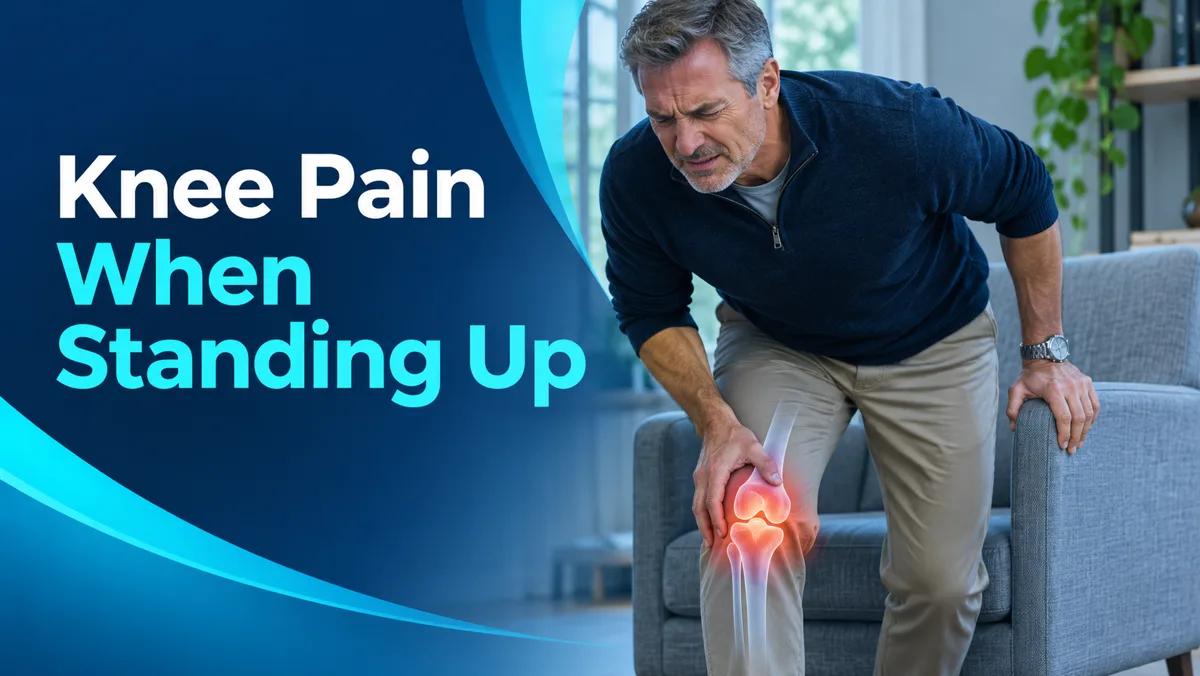
If your knee hurts most when you rise from a chair, the movement may feel worse than walking once you are upright. This sit-to-stand task places load through the kneecap, thigh muscles and joint surfaces while the knee moves from a bent position. Pain during it can have several causes, including patellofemoral problems, osteoarthritis, tendon irritation or another joint condition. The exact location, swelling and history of injury help identify what needs attention. One movement alone cannot diagnose the knee.
Why rising from a chair loads the knee
To stand, the thigh muscles must straighten the knee while the hips and trunk help lift the body. A low sofa requires deeper knee bending and greater effort than a higher firm chair. Holding the arms out, leaning forward or using the armrests changes the load. Pain may therefore vary with seat height even when the underlying condition has not changed. That does not make the symptom imaginary; it means the movement provides clues about how the knee is being stressed.
Note whether the pain is at the front of the knee, along one side, deep inside or behind it. Does it improve after several steps, or worsen as you keep walking? Is there swelling, stiffness, catching, locking or giving way? A clinician can use these details with an examination. Our Subchond article on knee pain going downstairs covers a related but different task. This page focuses on the load and symptom pattern of rising from a seated position.
Pain around the kneecap
Patellofemoral pain often causes discomfort at the front of the knee during activities that bend it under load. Patellofemoral arthritis can also hurt when rising from a low chair, as the American Academy of Orthopaedic Surgeons notes. The kneecap joint is not the only possible source of front-knee pain, so an examination matters. The clinician may assess movement, muscle strength, tenderness and whether the knee is swollen.
A person with front-knee pain may find a higher seat temporarily easier. That can help daily function while a rehabilitation plan is developed. It does not prove the problem is simply weakness. Sudden swelling, trauma or severe loss of motion calls for a different assessment. The goal is to understand why the task hurts and choose treatment that improves function, not only to avoid every chair that triggers pain.
Could it be osteoarthritis?
Knee osteoarthritis is a whole-joint condition involving cartilage, bone, joint lining and other tissues. It may cause stiffness after rest, pain with loading and difficulty with everyday tasks such as standing from a chair. However, not every adult with sit-to-stand pain has arthritis. A younger athlete, someone with a recent injury or a person with focal pain may have a different cause. An X-ray can help assess joint space and bone changes when clinically indicated, but the image should not replace the examination.
The NICE osteoarthritis guideline recommends therapeutic exercise as a core treatment. The plan should be tailored to the individual and may include strength and aerobic activity. Pain may increase briefly when exercise begins, so progression and follow-up matter. Avoid interpreting every discomfort during rehabilitation as new joint damage. Equally, a knee that becomes much more swollen or painful needs reassessment. The balance is guided loading, not forced exercise.
When does bone beneath cartilage matter?
The bone under the cartilage can contribute to deep knee pain, especially when it is stressed or shows a bone marrow lesion on MRI. Sit-to-stand pain by itself cannot identify a bone marrow lesion. The clinician must relate imaging findings to where the pain is and what activities provoke it. Our guide to cartilage damage versus a bone marrow lesion explains the distinction. It is possible to have both cartilage and bone changes, with different implications for treatment.
If pain is severe and appeared abruptly without a major injury, a clinician may consider other causes such as a subchondral insufficiency fracture. That is not a diagnosis to make from an online symptom list. The Subchond insufficiency fracture article describes why a sudden change in pain and load tolerance can need timely assessment. Continuing high-impact activity through escalating deep pain is not a sensible experiment.
What about a meniscus injury?
Meniscus problems can produce pain along the joint line, swelling or mechanical symptoms. Rising from a chair may hurt, especially if the knee twists during the movement. Yet MRI findings can be present without being the main pain source. A clinician considers the injury history, examination and whether the knee truly locks or only clicks. The meniscus root tear guide addresses a specific injury that can change loading of the underlying bone.
Do not assume that a meniscus tear automatically requires surgery. Some people improve with rehabilitation, while others may need a procedure depending on the tear and symptoms. A proper diagnosis prevents a generic treatment from being applied to very different problems. Pain during one daily task is a starting point for assessment, not proof of a particular tear.
What can you try safely?
If there was no injury and symptoms are mild, try a firmer, slightly higher chair and use the armrests while you seek advice. Avoid dropping into or pushing abruptly out of a low seat. Gentle movement and an exercise plan within tolerance can help maintain function. A physiotherapist may work on quadriceps and hip strength, movement control and confidence with sit-to-stand. The exact exercises should reflect the diagnosis, age, balance and other conditions.
Do not stop all movement out of fear that standing is wearing away the knee. Also do not repeatedly perform painful chair rises to test whether the knee has healed. Track how many repetitions are comfortable, whether pain settles and whether the next day is worse. If you need pain medicine, discuss the choice with a clinician, especially if you have kidney disease, stomach problems or take blood thinners. A safe plan should improve daily function without masking a serious condition.
When should you seek medical attention?
Arrange a review if pain persists, worsens, causes a limp or limits ordinary activities. Seek prompt care after an injury, with marked swelling, inability to bear weight, true locking, fever with a hot joint or a new deformity. A sudden severe deep pain after minimal trauma in an older adult deserves assessment. Bring previous imaging and a clear timeline of symptoms. The clinician may begin with examination and weight-bearing X-rays, using MRI when it will answer a specific question.
Treatment should address the source of pain and the person's goals. Strengthening and load management are often useful, but some structural problems require a different approach. A Subchond consultation can review symptoms and imaging together; it should not begin with an assumption that every painful knee needs an injection or replacement. The right next step depends on the whole joint and the person using it.
Frequently asked questions
Why does my knee hurt when I stand but improve after walking?
Stiffness after rest and load through a bent knee can produce that pattern, but several conditions may cause it. Location, swelling and examination help distinguish them.
Is it always arthritis?
No. Patellofemoral pain, tendon problems, meniscus injury and other causes are possible. A clinician can assess the pattern rather than assuming arthritis from age alone.
Should I stop using stairs and chairs that hurt?
Temporarily changing seat height or using support may reduce symptoms. Long-term avoidance is rarely the whole plan; guided rehabilitation can help restore function where appropriate.
Do I need an MRI?
Not automatically. Examination and sometimes weight-bearing X-rays may be enough initially. MRI is useful when a specific question about soft tissue or bone will change care.
When is standing pain urgent?
Seek prompt assessment for inability to bear weight, major swelling after injury, a hot joint with fever, true locking, deformity or sudden severe deep pain.